VINCENT VAN GOGH
INTERPRETATION CENTRE
Understanding Vincent van Gogh’s contribution to modern and contemporary painting
The Vincent van Gogh Interpretation Centre at the Estrine Museum is part of the visitor experience offered in Saint-Rémy-de-Provence, in the heart of the landscapes and places that inspired the painter:
– Saint-Paul de Mausole, which strives to create the conditions for a privileged introduction to the world in which Vincent van Gogh lived during his stay in Saint-Rémy-de-Provence.
– The Tourist Office, which offers guided and self-guided tours.
CHRONOLOGY
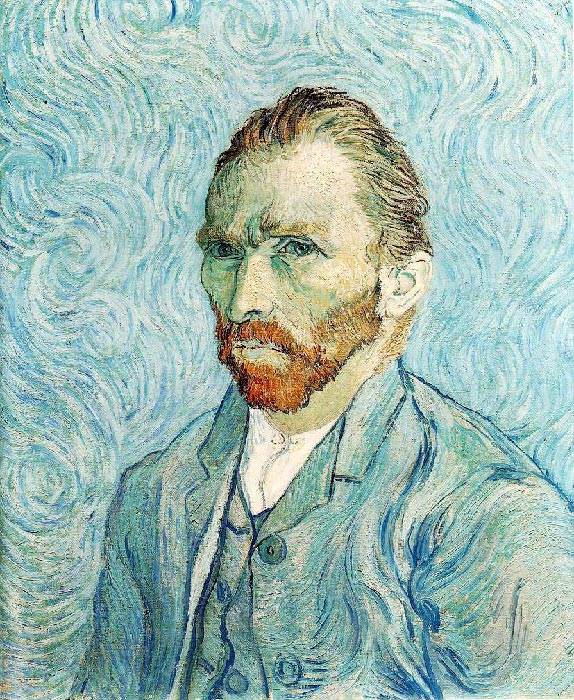
Vincent van Gogh
Groot Zundert (Netherlands) in 1853 — Auvers-sur-Oise, 1890
1890: First article devoted to Van Gogh by Albert Aurier
First painting sold
Death of Vincent
1891: Death of Theo
Posthumous participation in the Salon des Indépendants
1892: First retrospective exhibition in the Netherlands
1893: First publication of some of the letters in French
1901: First solo exhibition in Paris at the Bernheim-Jeune Gallery
1906: First appearance of the expression “cursed painter”
1907: First book reproducing his works
1910: First exhibition in London
1912: 116 works by Van Gogh are presented in Cologne
1913: First novel inspired by his life
1914: First fake Van Gogh paintings in Germany
1914: Publication of the letters in Dutch
1920: First psychiatric study
1928: First catalogue raisonné (J.-B. de La Faille)
1930: First publication on fakes
1935: First exhibition in the United States
1937: First major retrospective (Paris)
1938: Opening of the Kröller-Müller Museum, home to the world’s second-largest collection of works by Vincent van Gogh
1947: First pamphlet published and broadcast on the radio (Antonin Artaud)
1948: First documentary film (Alain Resnais)
1951: Exhibition in Arles and Saint-Rémy-de-Provence
1952: First complete publication of his writings (Netherlands)
1972: Opening of the Van Gogh Museum in Amsterdam
1983: Creation and opening of the “Fondation Van Gogh” association in Arles
1989: Opening of the Centre d’Art Présence Van Gogh in Saint-Rémy-de-Provence
1990: Exhibition marking the centenary of his death in the Netherlands
1995: Creation of the Valetudo art therapy association at the Saint-Paul de Mausole health centre
1997: Sale of Sunflowers, Irises and the portrait of Mlle Gachet for a total of 135 million dollars
1998: Opening of the Vincent van Gogh tourist centre at the Saint-Paul cloister
2007: The Centre d’Art Présence Van Gogh becomes a Museum of France under the name Musée Estrine
2012: Creation of the Van Gogh Europe Route
2014: Opening of the Fondation Van Gogh in Arles
2014: Renovation and extension of the Estrine Museum and the Vincent van Gogh Interpretation Centre
Based on the chronology by Nathalie Heinich, La gloire de Van Gogh, Editions de Minuit, Paris, 1991
Links:
Van Gogh in France:
https://www.fondation-vincentvangogh-arles.org
https://www.musee-orsay.fr
Van Gogh in Europe:
https://vangogheurope.eu/fr/
https://www.vangoghmuseum.nl/en
https://krollermuller.nl/fr/galerie-van-gogh
https://www.institutvangogh.org
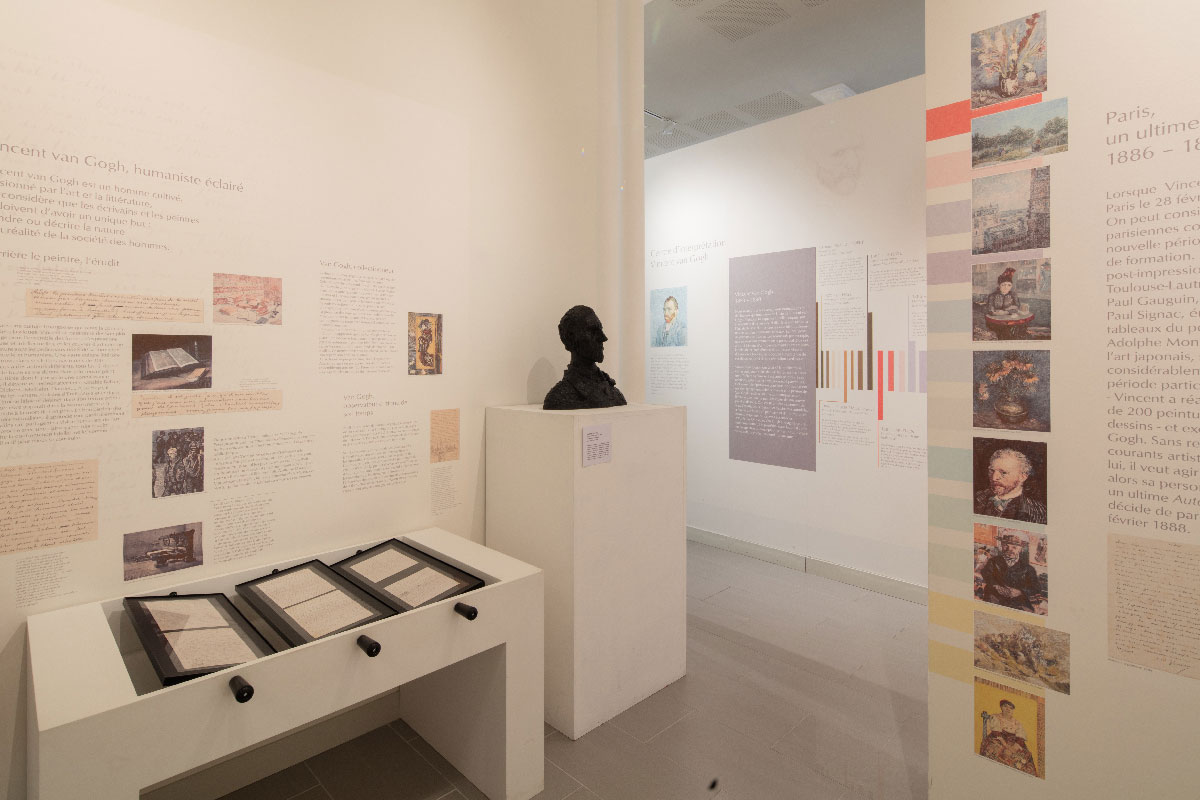
THE INTERPRETATION CENTRE
Since its creation, the Estrine Museum has paid tribute to Vincent van Gogh’s considerable contribution to modern and contemporary painting, to which the museum is dedicated. The name of the association responsible for the museum’s development, Présence Van Gogh, and the creation of an interpretation centre dedicated to the painter reflect this commitment.
During the year Vincent van Gogh was treated at the Saint-Paul de Mausole Hospice (May 1889 to May 1890), he created numerous drawings and nearly 150 paintings, many of them masterpieces. It was undoubtedly in Saint-Rémy that the Dutch artist’s radiant genius reached its full expression.
The landscapes of Saint-Rémy and the foothills of the Alpilles remain today much as Vincent discovered them more than a century ago.
To pay tribute to Vincent van Gogh, who lived in Saint-Rémy-de-Provence from 8 May 1889 to 20 May 1890, the Estrine Museum has created a multimedia educational space dedicated to the painter’s life and work.
The Vincent van Gogh Interpretation Centre allows visitors to rediscover the human and artistic journey of this exceptional figure, and his influence on artistic creation from the 20th century to the present day.
A space dedicated to The Life of Van Gogh
A space dedicated to Van Gogh, Humanist and Man of Letters
A space dedicated to Van Gogh’s Letters
A space dedicated to Van Gogh, Father of Modern Art
A space dedicated to Van Gogh’s Inspirations
A film about Van Gogh and the Alpilles, “I Saw the World This Way…”
The Estrine Museum is a partner of Van Gogh Europe (https://vangogheurope.eu/fr/), a major European project bringing together places and museums connected with the life and work of the painter.
The partners of Van Gogh Europe aim to fully promote the life and work of Vincent van Gogh by developing high-quality cultural, educational and tourism projects.

Plan Your Visit
BiographY
Vincent van Gogh
Groot Zundert (Netherlands) in 1853 — Auvers-sur-Oise, 1890
We are all familiar with the dramatic and painful events that were part of Vincent van Gogh’s life: the tragic episode of his severed ear, his confinement in an asylum and his suicide at the age of 37. While we are familiar with some of his most important paintings, such as The Potato Eaters or Sunflowers, what do we really know about the personality of this artist? The image of a “cursed painter” creating emotionally vibrant paintings in solitude and indifference has too often overshadowed the importance of his discoveries and his artistic “revolution”.
Vincent van Gogh left us his entire correspondence: more than 800 letters written to his brother Theo and his family, to his painter friends, acquaintances, art dealers and friends have survived. This body of correspondence is not only a day-to-day account of Van Gogh’s life and thoughts, but also a genuine literary work that cannot be separated from his paintings and drawings. In only 10 years of artistic work, this self-taught painter and draughtsman produced some 700 paintings and countless drawings, sketches and finished works.
At the dawn of the 20th century, Van Gogh imagined a “modern art” offered to posterity, in which he expressed his conception of art, nourished by a vast culture and profound humanism.
30 March 1853 – ZUNDERT
Birth of Vincent Willem van Gogh
His father, Theodorus, was a pastor. His mother, Anna Cornelia, was the daughter of a bookbinder. He was not their first child, but the child who, for the couple, replaced a first “Vincent”, who had been stillborn exactly one year earlier. For many critics, historians and academics, such as Charles Mauron, this episode would forever shape the artist’s character and psychology.
1872 – THE HAGUE
First correspondence with his brother Theo
Vincent grew up in a family with strong Christian values: virtue and work. After a disrupted education, he had to enter working life and was apprenticed at the Goupil Gallery. He remained there for five years before being dismissed. It was during this period that he developed a close relationship with his brother Theo, encouraged him to collect art, and began his first correspondence with him.
1880 – THE BORINAGE (Belgium)
Awareness of his artistic vocation
Vincent’s first vocation was to become a pastor. Like his father. Like his grandfather. Sent on a mission to the mining region of the Borinage, he showed charity to the point of self-sacrifice.
This commitment came to an end, and following a decision by the family council, he abandoned this path.
He then began to draw and considered devoting himself to art.
1882 – THE HAGUE
Vincent meets Clasina Maria Hoornik, known as Sien
Vincent fell in love with Sien, a prostitute, alcoholic, pregnant and the mother of a young daughter. Despite his family’s opposition, eager to start a family and full of hope, Vincent took her in.
Their relationship lasted two years, but ended in another romantic disappointment, his third.
1885 – NUENEN
End of his Dutch apprenticeship
Van Gogh continued his apprenticeship and followed the advice of the painter Anthon van Rappard. A hard worker and tireless draughtsman, he created his first paintings and declared himself “the painter of peasants”. Painting genre scenes and scenes of everyday life, he painted The Potato Eaters.
1886 – PARIS
Discovery of avant-garde movements
Vincent settled in Paris, and this stay permanently transformed his artistic path: he met Parisian artists and discovered the movements and artistic trends of the period, influences that would completely renew his vision as a painter. His palette became lighter, he developed an enthusiasm for Japanese art and discovered the work of Monticelli, which would soon lead him towards the South.
February 1888 – ARLES
The blossoming of his artistic genius: the Provençal Japan
20 February 1888 – Feeling “called”, Vincent settled in Provence. The dazzling sunlight of the South would transform his use of light and colour.
May 1888
Discovery of the Mediterranean
Vincent embarked on a five-day trip to Saintes-Maries-de-la-Mer.
He wrote to Theo: “Since I have seen the sea here, I am absolutely convinced of the importance of staying in the South and exaggerating the colour”.
September 1888
Moving into the “Yellow House”
Vincent moved into the “Yellow House” and hoped to establish a “Studio of the South” there, a genuine artistic community open to painters. He furnished it and, in October, invited the first of them: his friend Gauguin.
December 1888
Serious conflict with Paul Gauguin
The difficulties in the relationship between Van Gogh and Gauguin, and their opposing artistic and personal temperaments, turned into confrontation: Vincent attacked Gauguin, cut off the lobe of his left ear, and brought their shared adventure to an end.
May 1889 – SAINT-RÉMY-DE-PROVENCE
New landscapes
After the episode of the severed ear, Vincent accepted that confinement had become necessary.
He was admitted to the asylum of Saint-Paul-de-Mausole and decided to undergo treatment there. He continued his work as a painter, discovered new landscapes and developed a renewed connection with nature: the irises in the garden, the yellow wheat fields, the cypresses, the olive trees and their symbolic significance made a powerful impression on him.
June 1889
The Starry Night
Vincent’s style evolved. The crises that prevented him from painting were followed by periods of feverish activity. He worked from engravings by Millet, Rembrandt, Delacroix and Doré.
This exercise also liberated him, and he painted one of his greatest masterpieces, The Starry Night.
February 1890
Birth of Vincent, Theo’s son
The first signs of recognition, at last…
An article by the art critic Albert Aurier appeared in Le Mercure de France.
Vincent’s painting The Red Vineyard was purchased by Anna Boch, sister of the painter Eugène Boch.
May 1890 – AUVERS-SUR-OISE
Return to the North
20 May 1890
Vincent left the South and settled at the Ravoux Inn. He was treated there by Dr Gachet, a collector and friend of Pissarro and the Impressionists. Their relationship soon deteriorated, while Theo, overwhelmed by financial difficulties, spoke of returning to the Netherlands with his family.
Vincent believed he had been abandoned.
27 July 1890
The last paintings
At dawn, Vincent set off to paint in the fields with his easel… and a revolver, with which he attempted to end his suffering, before making his way back, with difficulty but only wounded, to his room. On him was his final letter, left to posterity: “…Well, my own work, I risk my life for it, and my reason has half foundered because of it…”.
29 July 1890
Vincent died in his brother’s arms.
He was buried in the cemetery of Auvers-sur-Oise on 30 July 1890.
Plan Your Visit