Roger Edgar Gillet – Information on works
Proposition I
From 1953 onwards, this painting was featured in several major exhibitions devoted to abstraction between 1952 and 1957, at the instigation of Michel Tapié, art critic and exhibition curator, who supported Roger Edgar Gillet in his early days. Belonging to the lyrical abstraction movement, the work is characterised by the emergence of a motif evoking an animal’s gaze within a dark, almost black material, punctuated with shades of red. Gillet considered this canvas to be the foundation of his pictorial language. Following the retrospective organised at the Musée de Saint-Priest in 1981, the artist adopted a simpler title, thus marking his distancing from the theoretical framework developed by Michel Tapié.
Saint Thomas
In 1958, when abstraction still largely dominated his work, Gillet showed this painting to his friend and dealer Jean Pollak. Pollak was surprised by what he perceived as a ‘portrait’, heralding a possible return to figurative art. The title, Saint Thomas, reflects this surprise; Jean Pollak kept the work in his flat for the rest of his life. Gillet later referred to this painting as a turning point: the transition from abstraction to a new exploration of the gaze. This evolution began after his first trip to the United States in 1955, following his winning of the Catherwood Prize. At the Metropolitan Museum of Art in New York, his discovery of El Greco’s Portrait of Cardinal Nino de Guevara was a revelation: ‘I told myself that with abstract painting, we were losing something: we could no longer paint the depth of the gaze.’ This realisation opened up a figurative adventure for Gillet, shared by several artists of his generation, such as Zoran Music, Eugène Leroy and Maryan.
Composition
Added to the collections of the Centre Pompidou – Musée national d’art moderne in 1963 via the Galerie de France, where Roger Edgar Gillet had three solo exhibitions between 1957 and 1963, this work marks a major transition in his career. The artist began a gradual return to the human figure, through hybrid and ambiguous forms. Critics sought to describe these singular figures: Jean Grenier referred to ‘moustachioed mascarons’, Yvon Taillandier to ‘barbaric totems’, then to ‘robot frogs with eyes like headlights’. Georges Boudaille, for his part, emphasised that ‘Gillet’s painting is perhaps evolving towards a form of figuration without renouncing its sumptuous craftsmanship’.
The Last Supper
Throughout his career, Roger Edgar Gillet maintained a constant dialogue with the religious iconography of the great masters. In 1962, a series of paintings entitled Apostles explicitly references El Greco’s work; in the same year, a sketch kept at the National Museum of Modern Art heralds this Last Supper, inspired by Leonardo da Vinci’s fresco. The work marks an important step in the artist’s evolution towards figuration and the search for the gaze. However, the eyes remain almost effaced: expressiveness relies mainly on posture, presence and the tension of the bodies. This canvas, from the United States, has only been exhibited once, during the retrospective dedicated to Gillet at the CNAP in 1987.
The Third World
From 1963 onwards, Roger Edgar Gillet increasingly focused on representing the body and its humanity. More than twenty years after the liberation of the extermination camps, he remained deeply affected by images of the great famines in India in 1965–1966. The title of the work, Le Tiers-Monde (The Third World), refers to the expression coined by Alfred Sauvy in 1952, in connection with the ‘third estate’. Used until the end of the 1960s, this term conveys both a political and a human dimension. In 2003, during an interview with Francis Marmande, the artist described this painting as one of his favourites: ‘The material is indestructible, there is not the slightest regret. It’s a painting that behaves well. It’s like a sword stroke. It ages perfectly.’
A bunch of people
Presented at the Salon de Mai in 1966, this work entered the collections of the Musée d’Art Moderne de Paris that same year. Influenced by Alain Resnais’ film Nuit et Brouillard (Night and Fog, 1956), Gillet kept the images of the extermination camps in his memory without ever depicting them directly, out of modesty and a sense of illegitimacy. The forgotten victims of wars, revolutions and famines deeply moved him and are implicitly present throughout his work. Through its format and the perspective of the piled-up bodies, the painting also evokes the great scenes of massacres by Delacroix and Géricault, which he discovered at the Louvre.
The Binches
In 1967, Gillet travelled to Cuba with nearly a hundred artists from the Salon de Mai to take part in the collective and festive creation of a large mural. This experience, combined with the events of 1968, fostered a more optimistic view of the world in him, tempered, however, by an ironic distance. In this spirit, Gillet revisited the carnivalesque world of James Ensor. He had long been fascinated by carnival, particularly that of the “Gilles de Binche”, which he discovered through his friend Pierre Alechinsky. In 1967, Alechinsky presented the exhibition L’univers des Binches (The World of Binche). The two artists shared a common taste for humour, readily described as “Belgian”, combining the grotesque, derision and formal freedom.
The Harem (Signal)
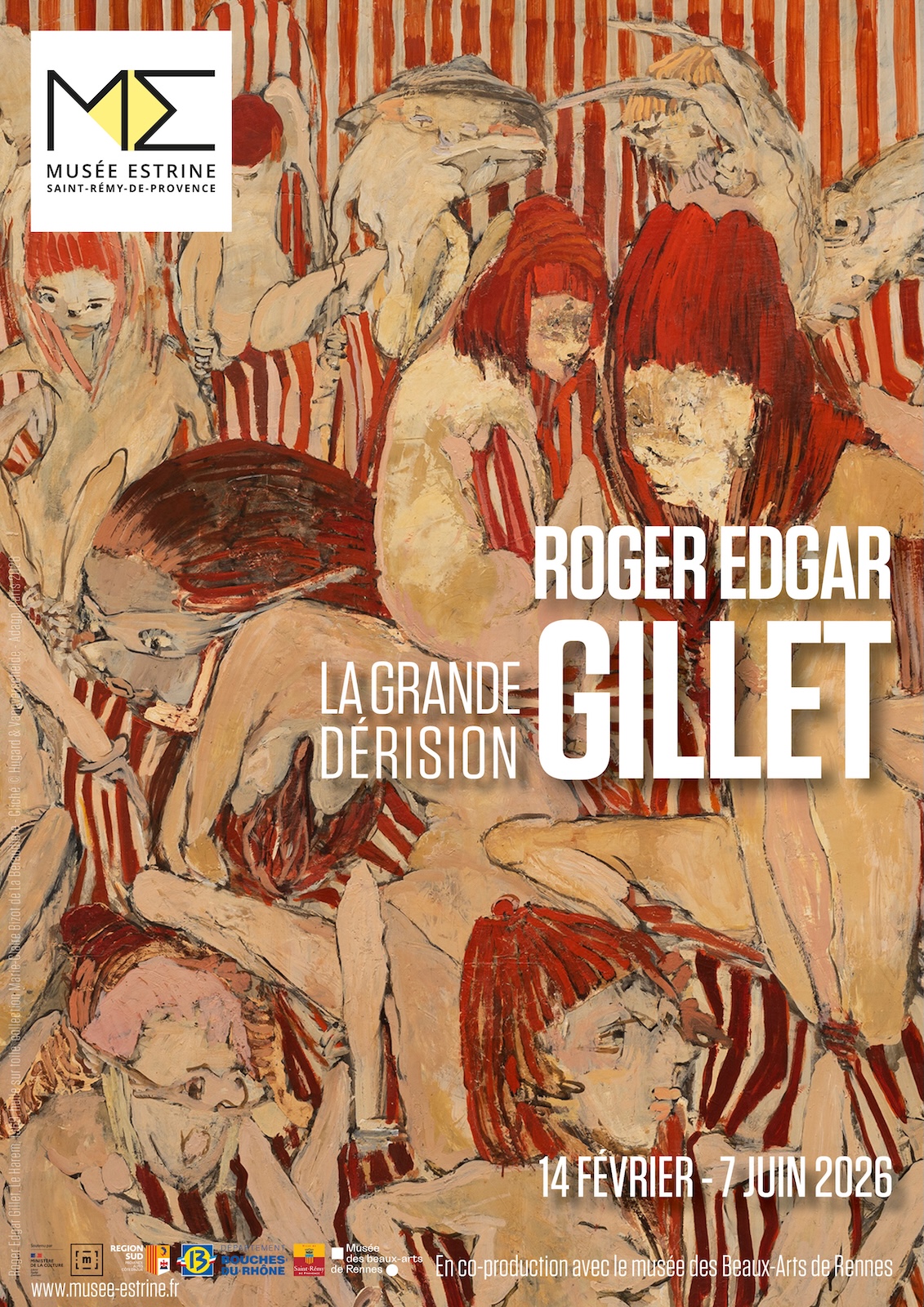
This work offers a deliberately excessive and ironic take on the harems painted by Delacroix and Ingres. The entire canvas is saturated with red: sophisticated hairstyles, striped drapes, armchairs and cushions create a theatrical and almost delirious setting. Between 1968 and 1973, Gillet produced around twenty paintings with backgrounds evoking striped or damask fabrics, inspired by the decorative world of his wife Thérèse, an interior designer. The word ‘Signal’ in the title is a humorous reference by the artist: a mockery of innovations deemed useless, such as the famous red stripes on Signal toothpaste, launched with great fanfare in the 1960s. Jean-Jacques Lévêque wrote in 1968: ‘A painting of dreamy reflections on life and the presence of beings and things.’
Club Méditerranée in Marrakech
In the early 1970s, following a trip to Tunisia, Gillet painted a series of cities and characters inspired by the Arab world. He developed this theme until 1976 in some thirty paintings with very rounded shapes, evoking both medinas and, in his own words, certain ‘new cities’ that he did not particularly like. Most of these cities are deserted; only two large-format works feature characters, including this Club Méditerranée in Marrakesh. Here we find a recurring motif in Gillet’s work: spectators seen from behind, placed at the bottom of the composition, facing the scene as if in front of a theatrical ‘fourth wall’. Gillet never visited Marrakesh or this club. The image, probably fuelled by memories, television images and ironic anticipation, reflects his critical view of the incongruous location of this architecture in the heart of the medina.
Untitled
After leaving Sens in 1981, Gillet moved to Paris with Thérèse, before returning every summer to the Saint-Malo region, to Saint-Suliac. From 1989 onwards, they lived there all year round. The artist then pursued a different kind of figurative art, deliberately remaining on the fringes of the dominant issues of modernity. He painted a series of ten large-format works entitled La marche des oubliés (The March of the Forgotten), exhibited at the FIAC, then developed a series known as Les Tempêtes (The Storms). This painting belongs to the latter series and evokes the surrounding coastal landscapes. Gillet seeks to convey both the energy of nature and that of the pictorial gesture. The inks are reminiscent of those of Victor Hugo; the oils dialogue with Turner. Although the sea is rough, the colours lend this large format a surprising serenity.
The Philosopher
In the early 1960s, Gillet’s first portraits took the form of Apostles, culminating in The Last Supper in 1963. Forty-five years later, as he began to lose his sight, the artist returned to this theme in a final series of Apostles with violently altered faces. After, in his own words, ‘tyrannising’ the figures of bigots, judges and officials, Gillet seems to be bringing his career as a painter to a close. The titles, which he himself describes as ‘modes of non-use’, are less important than the subject matter. During the exhibition Le visage qui s’efface (The Fading Face) in Toulon in 2008, Itzhak Goldberg wrote: ‘It is neither dissolution nor fragmentation, but a fusion with the material.’ Beneath barely visible eyes, the face is violently erased, as if crushed by fingers, from the ear to the neck.
The Executed
Gillet has always acknowledged his great admiration for Goya, whose themes he revisits in a dozen paintings produced between 1980 and 1997, notably Les Fusillés (The Executed), which reinterprets the subject and structure of Tres de Mayo. The composition is based primarily on a play of chromatic contrasts. Powerful, almost black browns encircle an ochre-white halo where the heart of the action is concentrated, deliberately offset from the centre in order to reinforce the feeling of imbalance between the shooters and the shot and to emphasise the injustice of the scene. The noise, movement and tension are conveyed by the undulation of the pictorial material, which gives rhythm to the action while focusing the scene on this circular space bathed in light, a veritable arena of death.
Préparez votre visite