First Room :
Albert Gleizes, Dragonfly or Arabesque, 1953
Albert Gleizes, Grey-brown Figure ou Grey-blue Figure, 1952
In 1950, Albert Gleizes delivers his artistic testament with his illustrations for Thoughts on Man and God by Blaise Pascal, in which he employs the full range of his previous plastic discoveries. In these etchings, Gleizes systematically uses the plastic theme of the arabesque, which soon resonates in his pictorial production.
Figure gris brun invites a melodic reading in which background and surface, form and figure merge. The arabesque line organizes a lyrical composition, where the fluidity of transparencies allows light to emerge. With this work of pure abstraction, the painter warns us against letting the eye linger on a single image. Delacroix writes to Baudelaire: “…These mysterious effects of line and color, […] this musical and arabesque aspect […] mean nothing to many people.” They are particularly significant for Albert Gleizes.
Albert Gleizes, Glorious Maternity, 1935
In this painting, which reinterprets the Christian iconography of the Virgin and Child, Gleizes surrounds the central blue, green, and red flat areas with a network of concentric circles in which the modified colors of the central harmony reappear. For Gleizes, this represents a relationship of order between color and light, for which he finds a model in the motif of the “Rainbow,” inherited from Romanesque painting, and which becomes increasingly important in his work. This painting, published in 1936 in the journal Abstraction-Création, serves as a manifesto: sacred art can coexist harmoniously with the language of abstraction as it takes shape during the 1930s.
Juliette Roche, Composition with Treble clef, c.1918
Juliette Roche and Albert Gleizes take refuge in New York during the First World War. Composition with Treble Clef, dated around 1918, is a farewell to Manhattan. This work illustrates the ambivalence between brilliance and abstraction, straddling Cubism and Dada. In the foreground, distinct elements such as the treble clef and the boat appear. The rest of the landscape in the background, more geometric, represents the island of Manhattan with its skyscrapers illuminated at night, between the Hudson and the East River.
The characteristic use of vibrant colors and bold lines brings this fantasized vision of New York to life. Composition with Treble Clef synthesizes all the questions of modernity embodied by the city of New York and its lights—speed, music, skyscrapers, and the growing consumer society. New York is the city of jazz and clubs; it is in the neighborhoods of Harlem and Greenwich Village that Juliette Roche discovers New York nightlife.
Juliette Roche, Still Life with Lilies, c.1952
Juliette Roche, Self-portrait, c.1950
In this intimate self-portrait, Juliette Roche presents herself in a classical pose, shown in bust with her head gently tilted to the right. Her gaze, lost in the void, evokes a deep sense of melancholy. Notably, she portrays herself at a mature age: strands of gray hair escape from her headdress, her face bears the marks of time, and her features reveal her years.
Second Room :
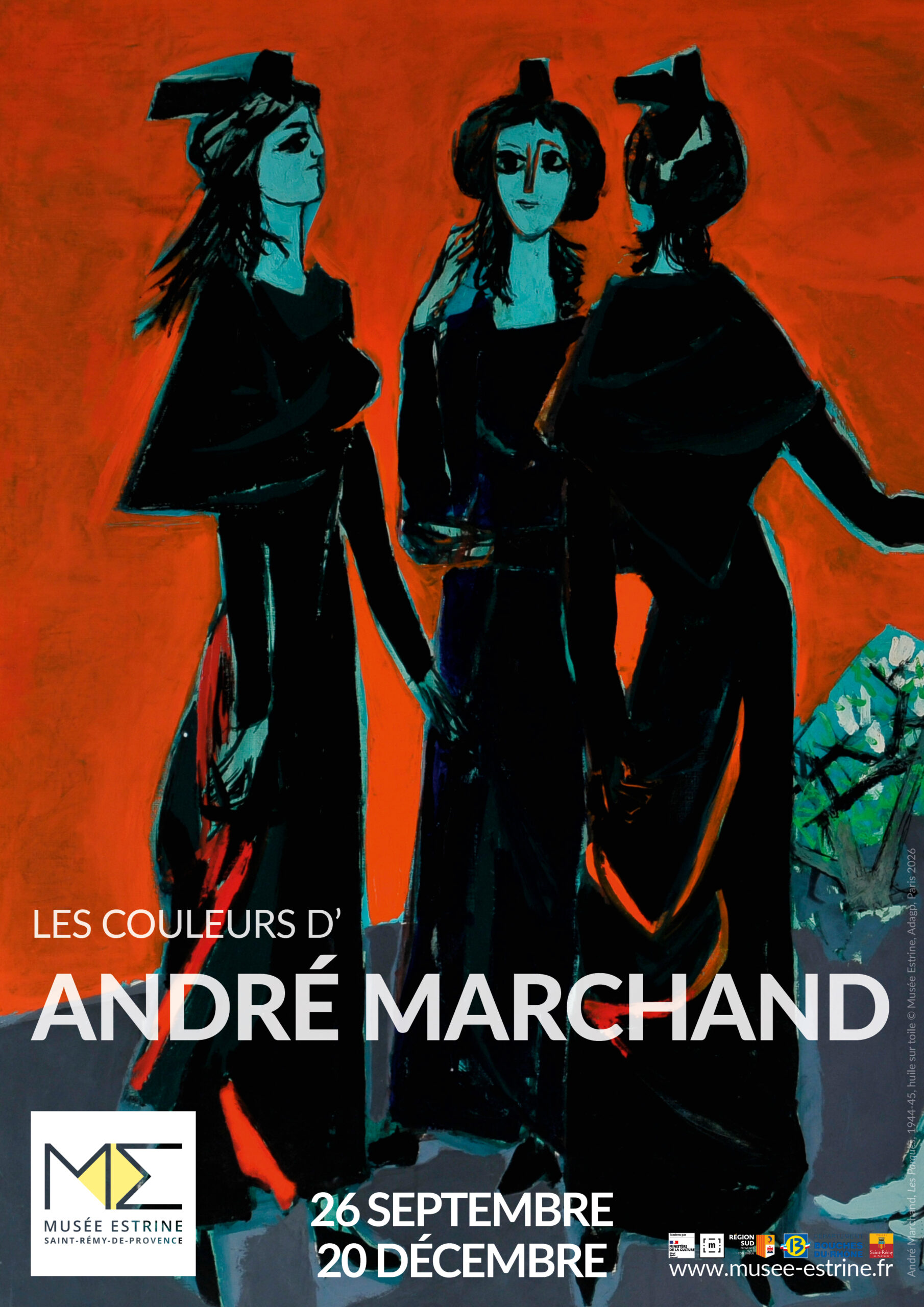
André Marchand, The Fiancés, 1935
The taste for the static, a passion for the immobile, form the guiding thread of his inner unity—a constant throughout his work. The silhouettes are stiff, frozen, as if petrified before a postcard-like setting, its colors muted.
Edouard Pignon, Roosters on fire, 1984
The Cockfights series is pivotal, as it forms a link between the work on the olive tree and the upcoming Wheat Pushersseries, and later the Battles. This large-scale canvas is a rather exceptional work, whose truly fragmented structure illustrates the implosion Pignon refers to when describing his painting.
The artist chooses a low framing at the height of the roosters to capture the movement and speed of the action as closely as possible. The black grid in the background seems to evoke the fencing of the “arena.” The roosters disappear into their plumage, becoming recognizable only through their attributes—combs or legs. The “frenetic” speed mentioned by the author is conveyed through the absorption of the bodies into a brushed red, contrasted with green. The image of the fight is treated like an explosion of flames, with the focal point located at the intersection of two large diagonals. The color palette, limited to complementary colors, further reinforces this effect.
Jean Pierre Blanche, The open Bay, 1975
Trained at the Fine Arts schools of Montpellier and Paris, Jean Pierre Blanche belongs to the generation of new figurative painters for whom drawing holds a central place. His work seeks to capture the surrounding world through landscape. Blanche spends his life along the Mediterranean coast and throughout the South of France, ultimately settling at the foot of Sainte-Victoire in Aix-en-Provence.
This 1975 painting is an explicit homage to Henri Matisse’s Window at Collioure. The artist explores the interplay between interior and exterior spaces, using texture and material to create dynamic visual effects. While Matisse renders black within the windowed landscape, Blanche opts for thick foliage, through which glimpses of blue sky appear. His brushwork and handling of material convey the subtle, persistent movements of light. For this work, Blanche is awarded first prize in 1977 at the Eleventh Monte-Carlo International Contemporary Art Competition—a significant recognition that, in the context of his career, makes this painting doubly historic.
Vincent Bioulès, Painting n°3, 1973
At this time, Vincent Bioulès paints vertical, monochrome panels. In doing so, he deliberately renounces his technical know-how and the cultural and emotional ties that bind him to the past. His paintings of the 1970s reduce painting to its most basic language: pure colors and the absence of subjectivity. To achieve this, he applies adhesive tape to his canvases, which determines “the distribution of colored surfaces” in vertical bands. The artist seeks to restore to color its independent reality.
In this work, the construction through vertical bands of color is evident. White occupies the top and bottom of the canvas, creating a sense of space. Drips of paint in the white areas and along the green band, as well as brushstrokes within the colored bands, make tangible the painter’s gesture—previously forbidden. This work marks the beginnings of a certain expressivity and foreshadows Bioulès’ return to figuration in 1974. “If I decide to return to figurative painting, it is to be freer, to have a wider field of investigation around me.”
Third Room :
Gérard Fromanger, The Pievina, 1993
La Pievina comes from the Quadrichromie series, in which Fromanger deconstructs the mechanical reproduction process of an image, isolating the four fundamental colors—blue, red, black, and white-yellow—which he works in isolation rather than blended together, as printing would require.
“In the logic of quadrichromy, at the next stage, one would superimpose them to recreate all the colors of the original document. Why must one necessarily follow this logic of reproduction? (…) I therefore decide not to superimpose the four colors placed side by side before me, but to bring them closer together, shifting them slightly, offsetting them just a little (…). In nature, there is no line or contour. (…) The line is what remains on the canvas after the mere passage of the brush. (…) It is a network of lines that makes up a face or a landscape.” (in Gérard Fromanger, Quadrichromie, Galerie Claudine Lustman, FIAC, 1993)
In this series, the painter employs one of his favorite plastic devices: the “color thread,” which dances and meanders throughout the work. This series culminates in the late 1990s in another major series, Les Rhizomes, resonating with the concerns of Deleuze and Guattari, where this “guiding thread” reappears.
Lucio Fanti, Urban Lilies, 1980
The Urban Water Lilies illustrate, in a different register, the poetic irony at play in the artist’s work. Inspired by Claude Monet’s famous Water Lilies, already depicted “politically” in a painting held at the Estrine Museum, Fanti transposes them into the city in this “100 figure” format. The leaves are no longer the subject of light effects but serve as supports for letters, leaflets, and words drawn from the language of the city/polis.
As Italo Calvino notes, Fanti’s painting seeks to build a bridge between Nature and Politics. Nature, or the “countryside,” is represented by Monet’s Water Lilies, while politics is embodied in the Urban Water Lilies, transformed into leaves printed with letters. The same kitsch palette of green, violet, and white is maintained, along with the deliberately smooth surface, leaving nothing to betray the hand, so that the illusion of illusion is complete.
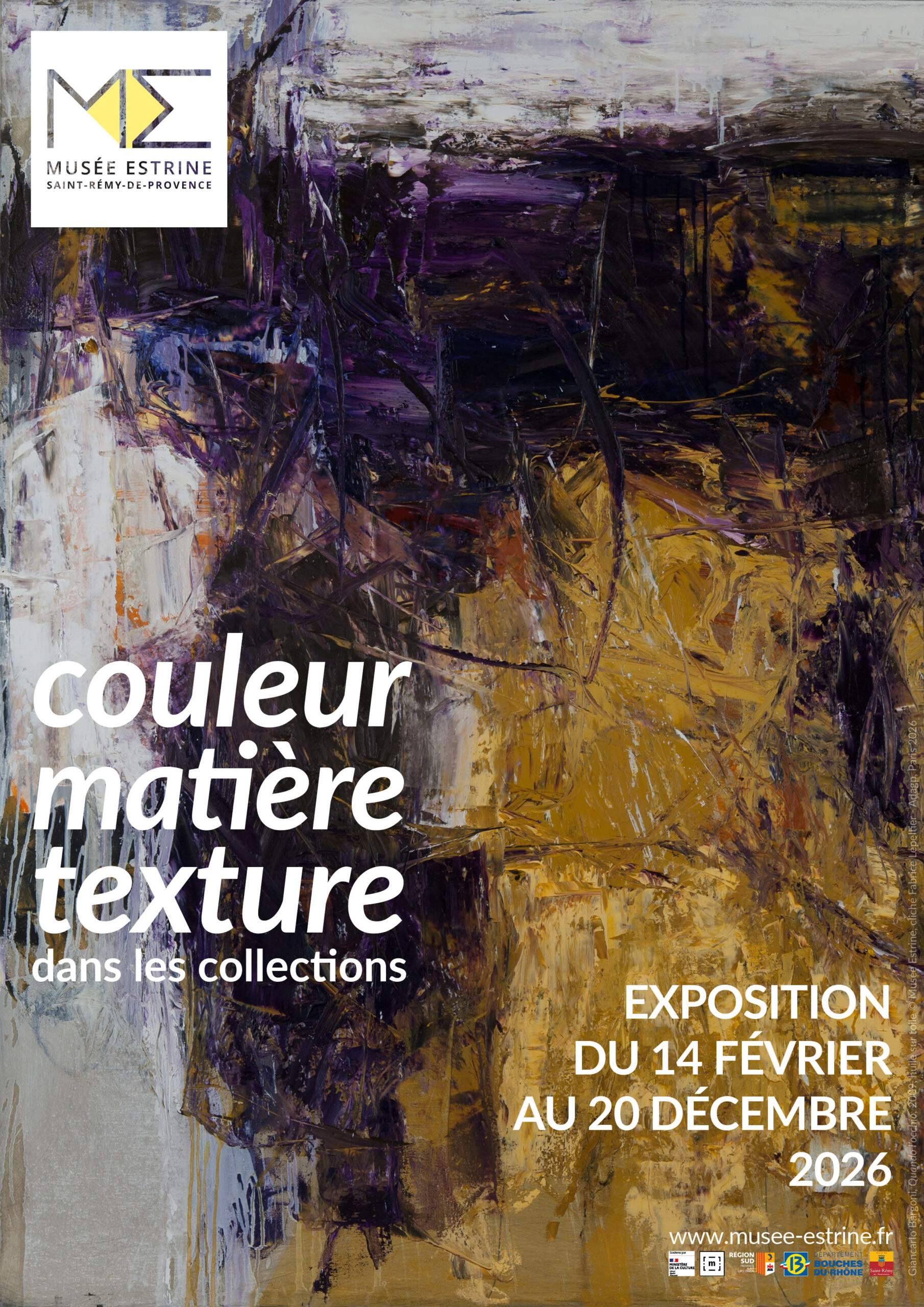
Giancarlo Bargoni, Quando l’occhio, 2009
Giancarlo Bargoni trains in painting at the Fine Arts School of Genoa. He studies the work of classical masters such as Giorgione, Tintoretto, and Raphael, while also exploring contemporary artists like de Kooning, Fautrier, Wols, and Rothko. He is awarded the Duchessa di Galliera Prize, which allows him to train in the arts of mosaic and fresco. He is later appointed Professor at the Fine Arts School of Genoa. A few years afterward, he embarks on a journey through Europe, Canada, and the United States. He exhibits alongside his friends Jacques Doucet and Karel Appel, and begins a long friendship with Piero Ruggeri, which proves invaluable for his understanding of technique and painters.
Bargoni quickly turns his attention to color, which becomes his primary focus. He explores effects of texture and light, as well as soft shadows. His work can be associated with artists already represented in our collections, such as Joseph Alessandri, Jacques Doucet, Lucien Lautrec, Eugène Leroy, Alfred Manessier, and Léon Zack.
Denis Laget, Untitled, 2003
Born in 1958 and trained at the Fine Arts School of Saint-Étienne, Denis Laget is undoubtedly one of the great painters of his generation, and also one of the most closely observed by younger artists. By choosing to work on small formats, addressing only classical subjects from the history of art—still lifes, bouquets, landscapes, skulls—Laget deliberately goes against the prevailing trends of the contemporary art scene.
This work belongs to a series of landscapes begun around the turn of the 2000s, described as “afflicted, both muddy and arid, scorched by the radiations of multiple suns” (Karim Ghaddab). The suns painted by Denis Laget are sickly, proliferating, necrotic, often blackish like carcinomas. “What I do,” he declares, “is not in glory. It is faded; there is corruption; there are dubious things.”
Geneviève Claisse, Composition, 2000
In 1958, Geneviève Claisse joins the studio of Auguste Herbin and becomes his collaborator. After the death of this great painter, she compiles the catalogue raisonné of his work.
Geneviève Claisse is a painter, printmaker, and sculptor. She is particularly interested in kinetic art, which gives her the opportunity to introduce multiple spatial dimensions into her paintings, while keeping them strictly governed by form and color. She applies highly refined colors in flat areas and uses perfect geometric shapes such as the circle—a symbol of spirituality—in contrast to the square, a symbol of materiality and heaviness.
The introduction of white into her works creates a third dimension, again in opposition to black motifs, resulting in pieces of great refinement. Claisse also produces monumental works and large-scale murals.
Préparez votre visite