Accueil 5 Museum 5 The Collections 5 André Marchand

André Marchand

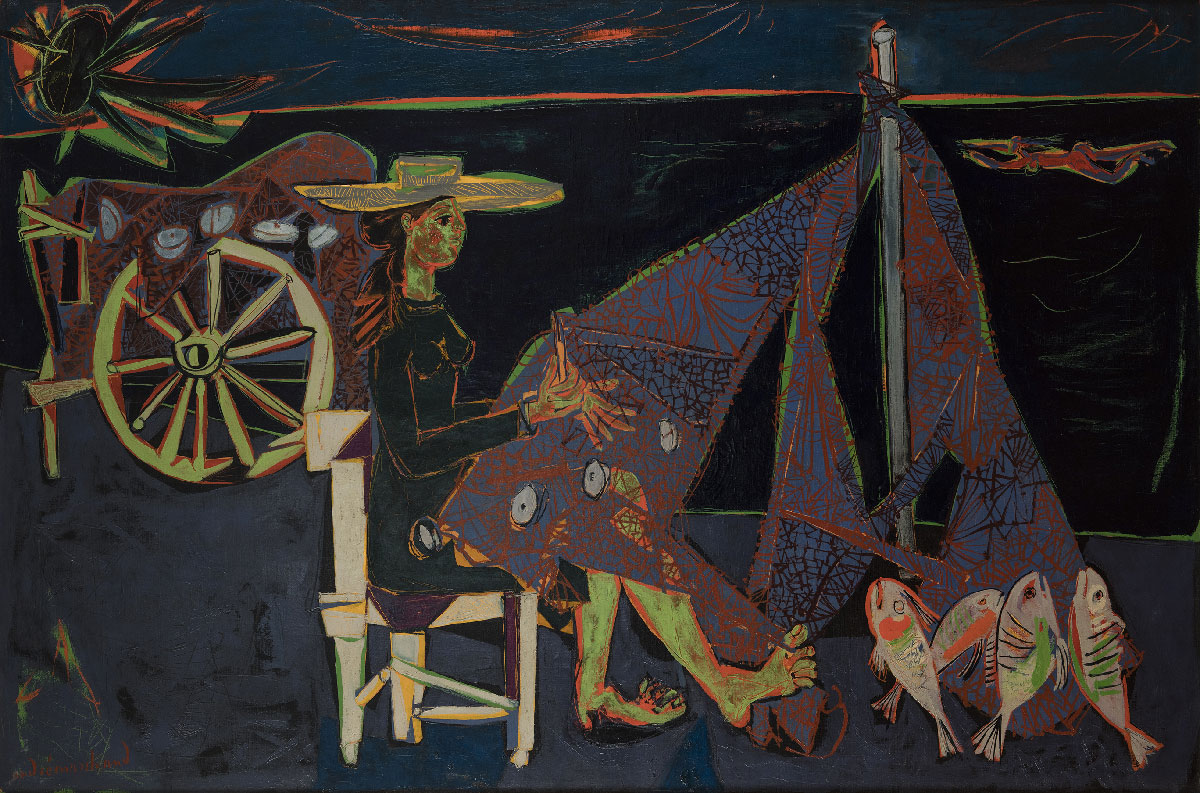
André Marchand (Aix en Provence 1907 – Arles 1997) Astarte, 1945 Oil on canvas Don Violaine Menu-Branthomme Inv. ME.2012.24 This very important 1945 painting is part of the series of the great black bathers presented at the Maeght Gallery which made the celebrity of André Marchand. Astarte is a goddess known throughout antiquity; she is Ishtar in Mesopotamia, Aphrodite in Greece and Venus in Rome. Astarte embodies both war, fertility and fertility, and protects sailors. In Marchand’s version, Astarte sits in the foreground and weaves fishermen’s nets At her feet, four fish arranged vertically echo a swimmer in the right corner of the composition. Marchand paints this scene on a black or very dark blue background, he emphasizes his drawing with orange reds, bright yellows or greens that isolate the characters from the background and reinforce the contrast. Credits: André Marchand, Astarté © Musée Estrine, photo Fabrice Lepeltier - Adagp, Paris 2023

Aix en Provence, 1907 — Arles, 1997

André Marchand is a painter, draftsman and lithographer. After secondary school in Aix, he moved to Paris in 1929 and attended the free academies of Montparnasse, but his only masters were at the Louvre where he spent long hours. At the same time, he undertook several trips to Algeria, the United States, Moscow, Warsaw and Vienna. His first paintings in Saint-Rémy date from 1935. After winning the Paul Guillaume prize in 1937 for his painting The Girl and the Paralytic, he became the leader of French painting. A friend of the poets Breton, Jacob, Saint-John-Perse, Queneau, Darius Milhaud and the painters Bonnard, Braque and Grüber, he is an essential artist of his generation. The works of his first artistic period, little colored, are made in a very fluid material. Demobilized in 1940, he joined Aix-en-Provence and rediscovered color. It therefore benefits from the recognition of critics and enjoys a particularly high reputation. In 1945, he made an exhibition at the new Galerie parisienne de Maeght where his famous «black bathers» earned him the praise of the critics of Chastel in Leymarie. Pierre Cabanne writes about him: «Our generation discovered him after the war and looked at him as one of his Masters». Tired of the artifices of Parisian life, he decides to withdraw into nature to which he devotes a fusional love. He set up workshops in Burgundy in 1946, in Arles in 1950 and later in Brittany, in Belle-Isle-en-Mer in the environment from which he found his inspiration. His painting seeks to express the power of nature through the motifs of landscape, woman, goddess of fertility, and still lifes that he prefers to call «silent lives». Provence, Aix, Arles, the Alpilles and the Camargue will always be present in its creation. A founding member of the Salon de Mai, he is represented by Galerie Maeght. He participates in the most important international events. Alongside his paintings, he illustrated many works, created costumes and ballet sets. He died in his workshop in Arles in 1997.
Exhibitions around the world have been devoted to him since the fifties, the Venice Biennale, Sao Paulo, etc. and his works appear in the largest museums, National Museum of Modern Art in Paris, Museum of Modern Art, FNAC, etc.
The Musée Estrine is the place of reference for the work of André Marchand, since it has benefited from a donation of more than a hundred works and now participates in the promotion and influence of this artist.

Prepare your visit
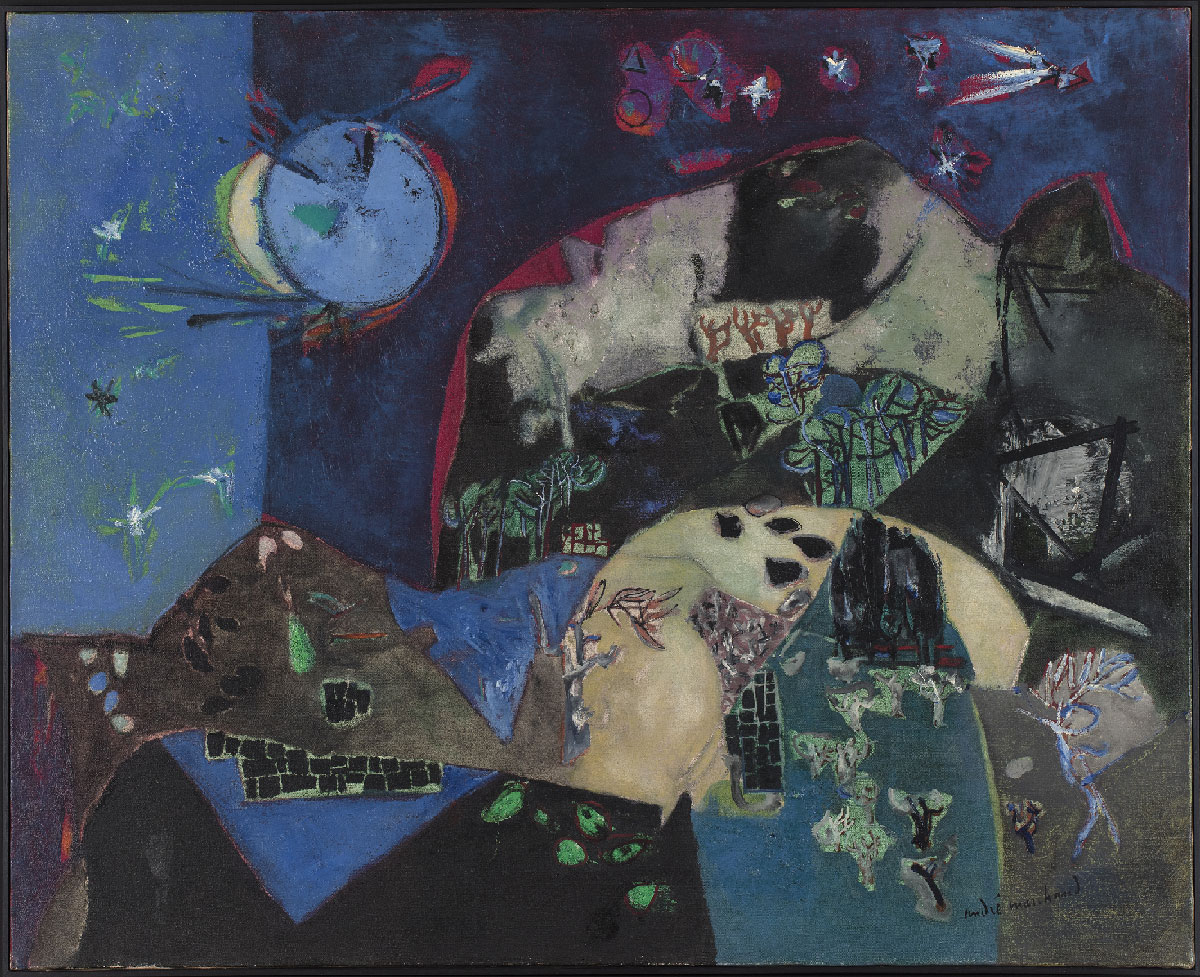
André Marchand (Aix en Provence 1907 – Arles 1997) Night in the Montagnette, 1946 Oil on canvas Don Violaine Menu-Branthomme. Inv. ME.2010.54 This work, represents the montagnette, small hill of 6000 hectares located between Barbentane and Tarascon in the vicinity of Saint-Rémy. The recurrence of this motif in Marchand’s work underlines his interest in «semi-mountainous» landscapes, such as those of the Alpilles or the Montagne Sainte Victoire. In its composition the landscape is divided into spaces of colors on which lie trees or stone walls extremely stylized. The color palette is made of gradient blues, blacks, greens and deep reds that reinforce the design by highlighting the ridge of the hills. The recourse to a composition in which marine blues and blacks are articulated and characteristic of the painter’s work in the late forties.The work on the night echoes all that could be called the cosmogonies of André Marchand, who is passionate about the effects of light, day in the water or night in the architectural cut-out of the natural or urban landscape.This work is also linked to the light of the Arles and Saint-Pierre nightsRémoise by Van Gogh who also saw in this light of the south an infinite support of contemplation. Note that Marchand supports his blues and blacks with dark greens and reds refusing the use of the contrasting dialogue «blue-yellow» of Van Gogh’s works. Finally, the Montagnette was also the scene of many landscapes and genre scenes of another artist from the region Auguste Chabaud who worked there since 1907 and found in these natural and vegetal architectures multiple sources of inspiration. Credits: André Marchand, La nuit dans la Montagnette © Musée Estrine, photo Fabrice Lepeltier - Adagp, Paris 2023
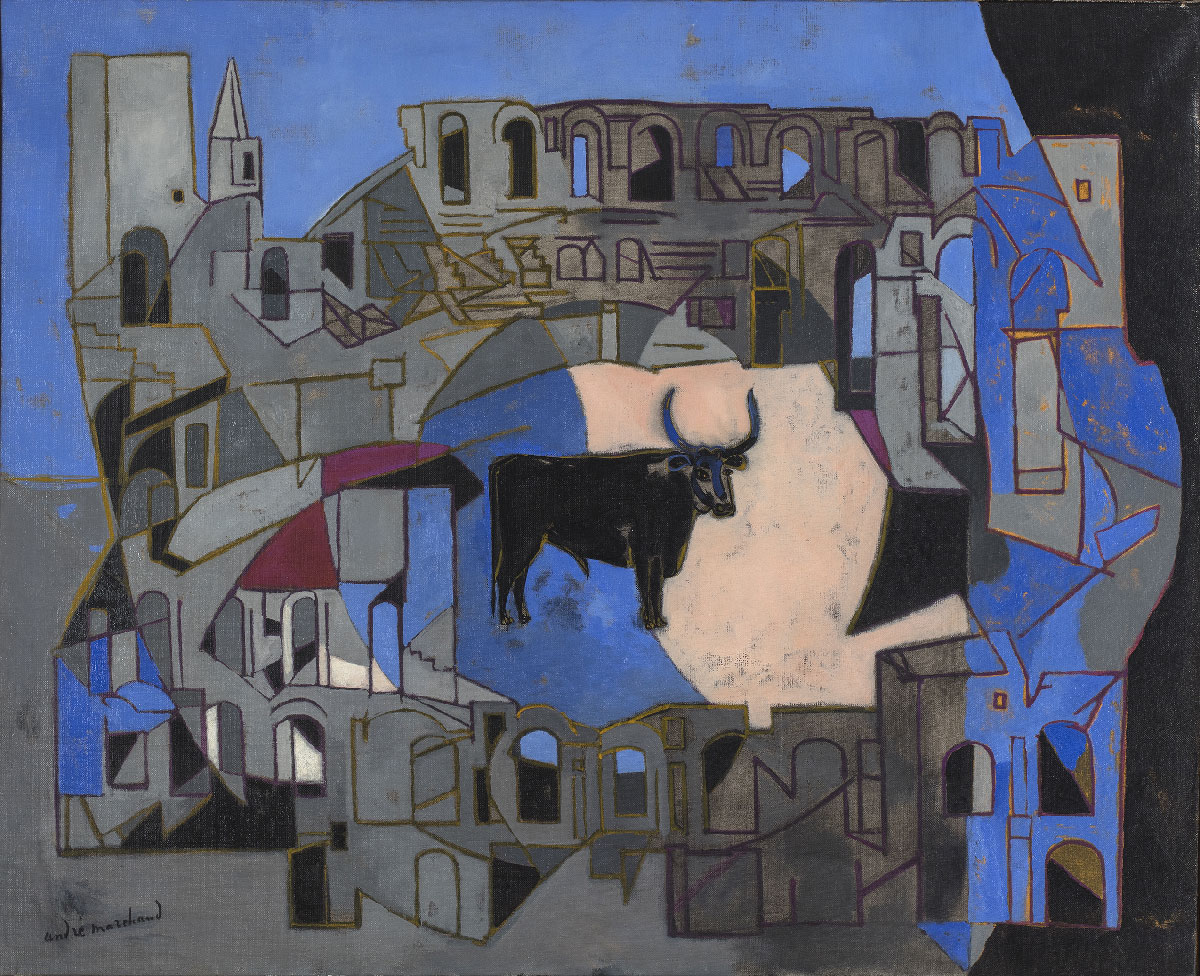
André Marchand (b at Aix en Provence 1907; d at Arles 1997) The Arena, 1950 Oil on canvas Don Violaine Menu-Branthomme. Inv. ME. 2007.48 Shortly after the arrival of Marchand en Provence, the curator of the Musée d'Arles, Jacques Latour, suggested that he move to the Musée Réattu. In 1950, Marchand discovered the Camargue whose landscapes enthuse him. In this wild nature as in the city of Arles, Marchand will meet the bull. This animal, which has embodied masculine power and fertility since ancient times, became one of the great subjects of his work. Marchand begins by representing him in the arena, as in this painting of 1950, but in an arena emptied of any human presence, where the animal alone, evolves in the middle of these architectures so characteristic. This solitude of the bull allows the artist to maintain his divine aura. The bull itself is a Camargue whose strength and audacity are admired, not a Spaniard doomed to death, which directs the painting to a very different reading. Planted in the middle of the arena like a god in the middle of his temple, he seems to challenge the spectator, connecting from his black mass the two large flat planes of king blue and white as a link between shadow and light. The arenas around him, rendered in dull grey with arcades precisely rimmed with complementary colors barely present, make it a showcase, a kind of halo in the middle of a sky of the same implacable blue. Credits: André Marchand, L'arène © Musée Estrine, photo Fabrice Lepeltier - Adagp, Paris 2023
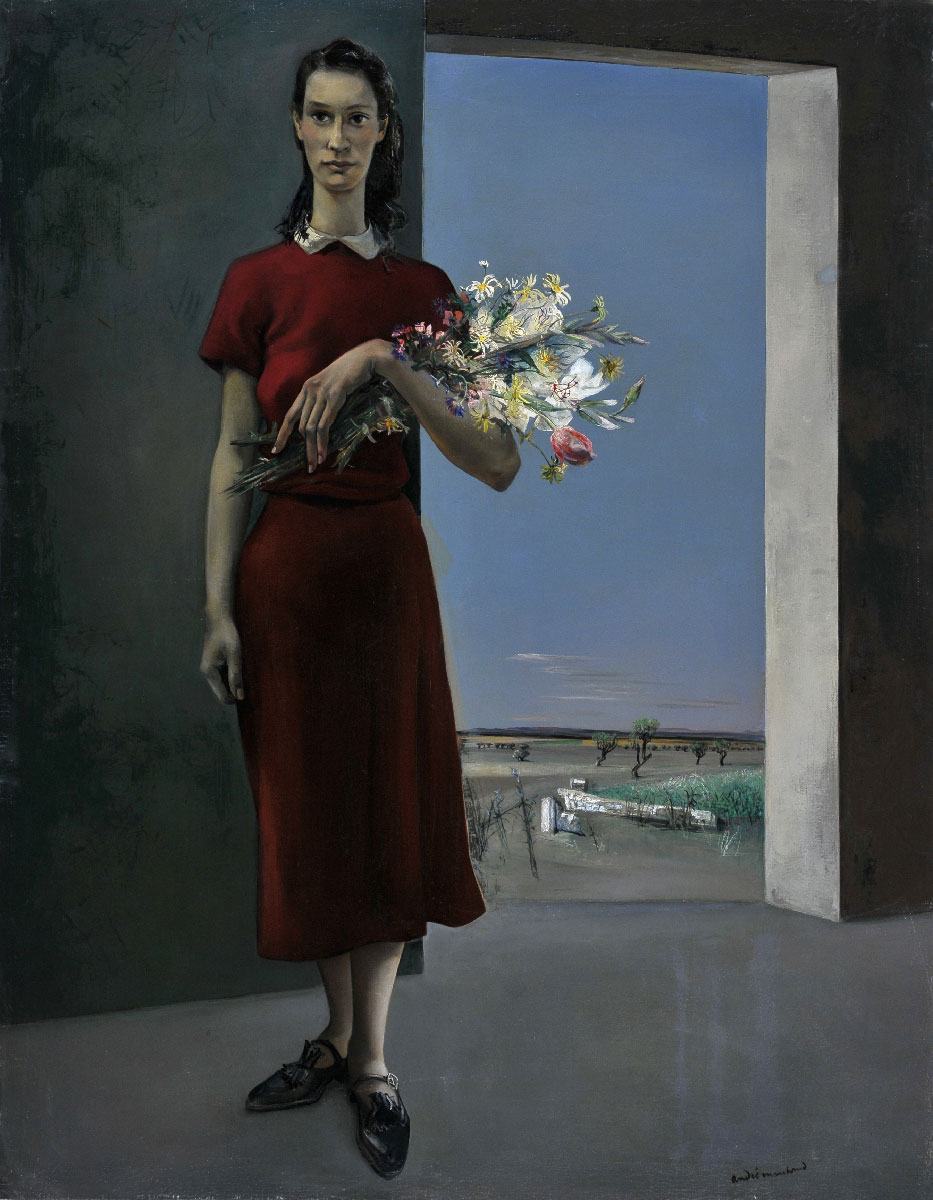
André Marchand (Aix en Provence, 1907 - Arles, 1997) The florist, 1937 Oil on canvas Purchase of the Estrine museum with the participation of FRAM. Inv. ME. 2010.53 Portrait de la Fleuriste or La fleuriste, 1937, is one of the first examples of a type of portrait that the artist puts in place in the 1930s and that he will decline repeatedly throughout his life. A woman is represented in a Mediterranean interior (with lime) very purified, opening, through a door, on a desert landscape. This portrait dates from 1937, the year Marchand received the Paul Guillaume Prize for The Young Woman and the Paralytic, a dark and symbolic work of the entire period. Unlike the latter, the portrait of the young woman (florist) is not stylized. Marchand wanted to get as close as possible to reality and faithfully represent the features of the face of this young woman. It echoes in this a large nude Sleep where we find the same personification of the model. All the plastic work on the models and the renderings of textures, from the clothes to the skin through the flowers is extremely delicate and comes to break with the previous style voluntarily more arid and schematic. The line is rounded and draws the body in motion of this young florist. The landscape with the blue sky of the right part is treated with more dryness coming to contrast the full-length portrait inside the work. Two universes linked by the bouquet of flowers that escapes everything in its treatment and location, the sky, and that embodies the passage between these two worlds. The desert, almost empty, of the landscape and the well-filled and alive of this young woman. An original painting, with a rare sensuality, which metaphorically illustrates a theme dear to the artist: melancholy. The ephemeral beauty and passing time are symbolized by the bouquet of flowers that will soon lose its shine. Credits: André Marchand, La Fleuriste © Musée Estrine, photo Fabrice Lepeltier - Adagp, Paris 2023

Albert Gleizes

Juliette Roche