Accueil 5 Museum 5 The Collections 5 Albert Gleizes

Albert Gleizes

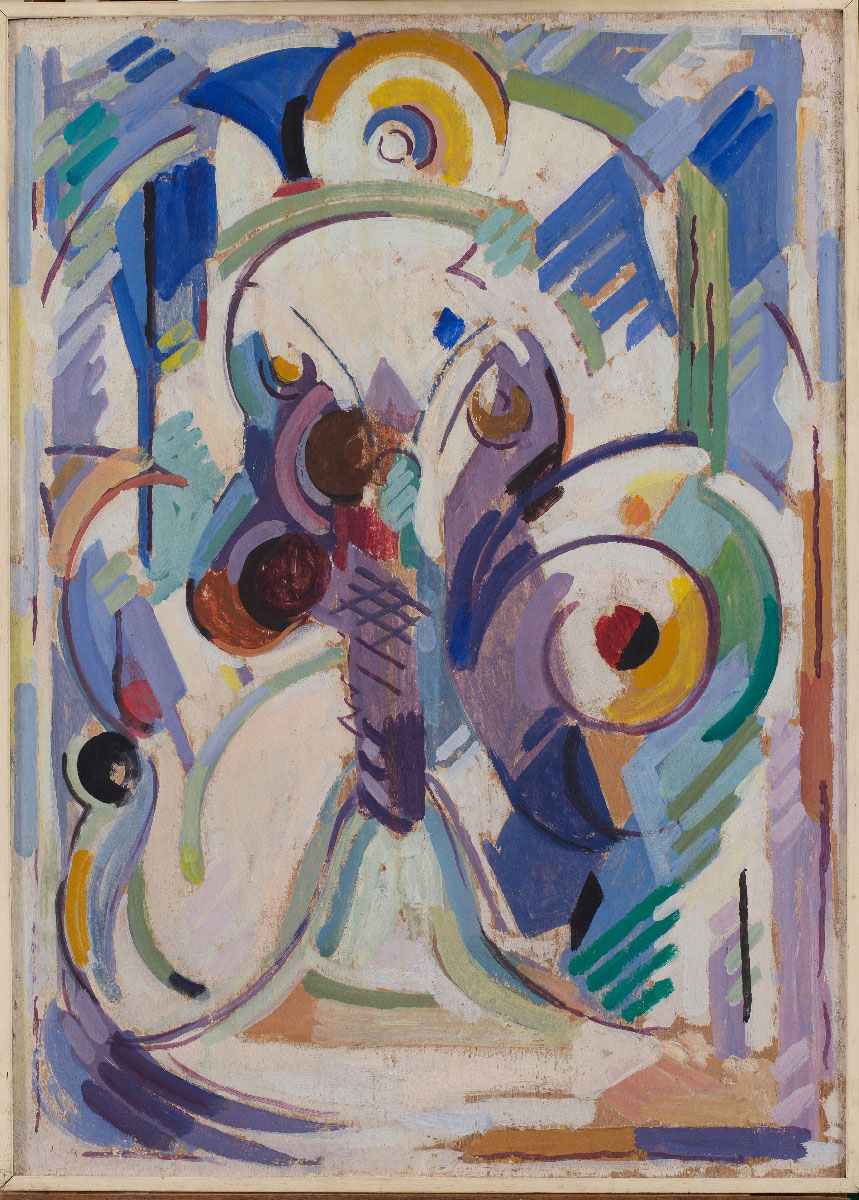
Albert Gleizes (Paris, 1881 – Saint-Rémy-de-Provence, 1953) Arabesque, also known as The dragonfly, circa 1952 Oil on wood Deposit of the Albert Gleizes Foundation, Paris In 1950, Albert Gleizes delivers his artistic testament with his illustrations for Blaise Pascal’s Les Pensées sur l'Homme et Dieu, where he uses all of his previous plastic discoveries. In these etchings, Gleizes systematizes the recourse to the plastic theme of the arabesque which soon finds an echo in his pictorial production. The Dragonfly invites a melodic reading in which background and surface, form and figure merge. The arabesque line organizes a lyrical composition, in which the fluidity of the transparencies allows the light to flow. With this work of pure abstraction, the painter warns us against stopping the eye on an image. Delacroix wrote to Baudelaire: “… These mysterious effects of line and colour…this musical and arabesque part…is nothing to many people.” They were particularly important to Albert Gleizes. Credits: Albert Gleizes, La libellule © Fondation Albert Gleizes, photo Fabrice Lepeltier - Adagp, Paris 2023

Paris, 1881 — Saint-Rémy-de-Provence, 1953

Painter, engraver, illustrator, author, Albert Gleizes left a masterful work.
In his youth, he worked in his father’s furniture design studio. In 1906, he was a founding member of the Créteil Abbey group, a house of writers and artists. In 1908, he met Delaunay and Metzinger with whom he wrote in 1912 a treatise «Du cubisme». In 1911, in the famous room 41 of the Salon des Indépendants, he participated in the consecration of the cubist movement. He exhibited at the Section d’Or and the Salon d’Automne until 1914. Demobilized in 1915, he married Juliette Roche and stayed in New York. He exhibited in Barcelona in 1916 with the Picabia and Marie Laurencin. He oscillates in his painting between the influence of the researches of Picabia, Duchamp and Blue Reiter. Back in France in 1919, increasingly concerned about social and intellectual issues, he taught a few students «Painting and its laws» in order to transmit and develop the discoveries of Cubism in painting. From 1923 to 1926, he developed his theories on Translations-Rotations and Cadences in painting. In 1927, he revived in Moly-Sabata, in Isère, the experience of the Abbey of Créteil with the participation of artists-craftsmen. The ceramist Anne Dangar and the painter Pouyaud settled there. He gradually retired from the Parisian artistic milieu. In a process of spiritual research, he joined the Abstraction-Creation movement in 1931, seeing in artistic abstraction a way to fight against the materialism of thought. He gives a series of lectures in Warsaw, London and at the Bauhaus. The year 1934 marked a major milestone in his research on the rhythmic denouement of painting, and, in parallel with these concerns, wall decoration was an important part of his work, which he exhibited in 1937 alongside Léger and Survage. In 1939, the couple settled permanently in Saint-Rémy-de-Provence, at the Mas des Méjades where they created a community of artists. Albert Gleizes converted to Catholicism and wrote «L’homme devenu peintre» which summarizes all of his research. Many intellectuals and artists will come to meet him. In 1950, he illustrated the «Thoughts of Pascal», which he considered his artistic testament.
Albert Gleizes has written several theoretical works in which he outlines his concerns and research. He is considered with Metzinger as a precursor and theorist of the cubist movement. Subsequently, he was more interested in composition and dynamics than in form. In 1953, for the last time during his lifetime, he participated in an exhibition on cubism organized by the M.N.A.M. His works are presented in the largest museums in the world and in the most important collections. The Estrine Museum permanently exhibits a retrospective of his works and holds several works by this artist considered an important representative of the French cubist movement.

Prepare your visit
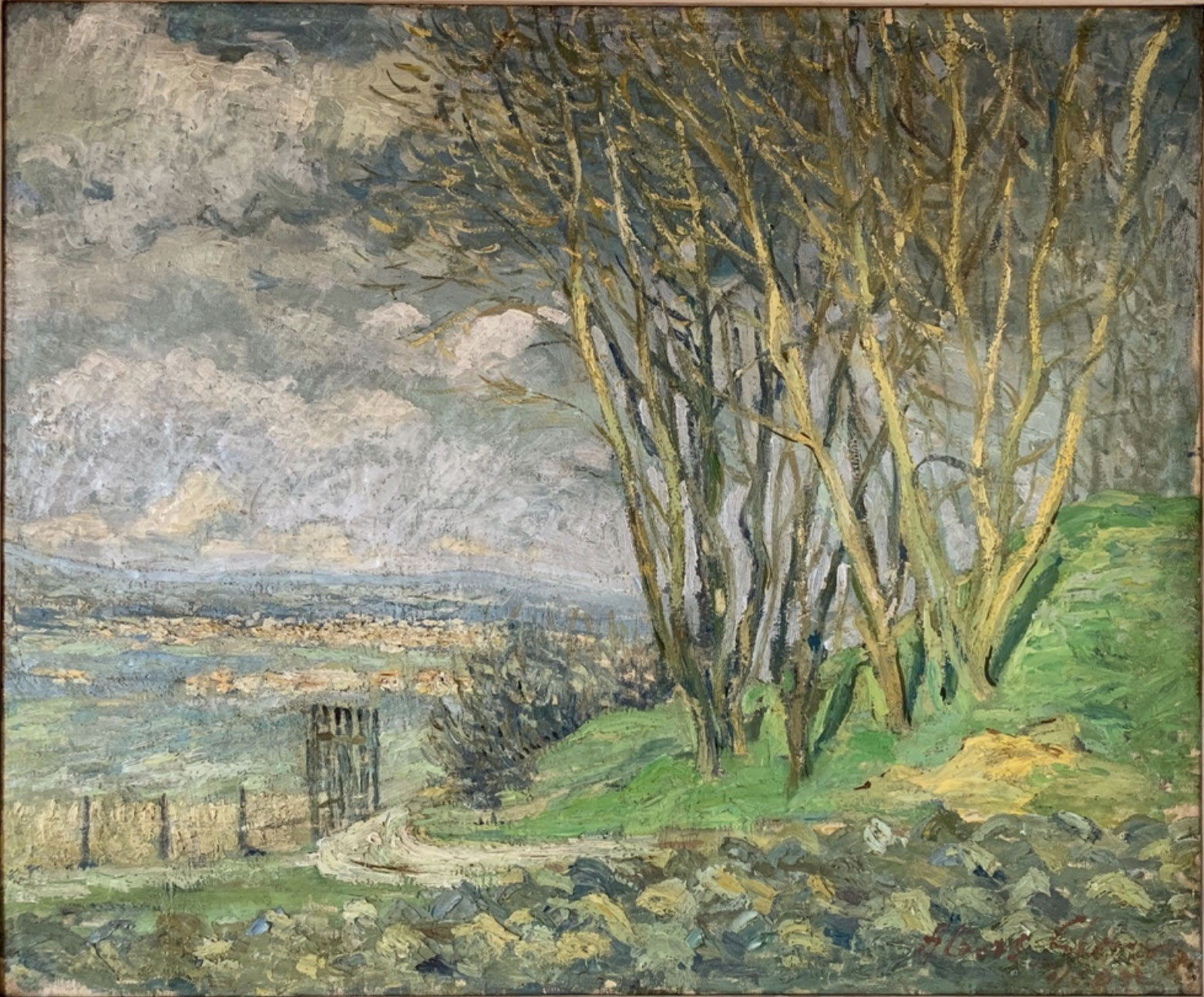
Albert Gleizes (Paris 1881 – Saint-Rémy-de-Provence 1953) Landscape with a bouquet of trees, 1901 Oil on canvas Albert Gleizes Foundation Depot, Paris 1901 is an important year in the life of Albert Gleizes since it is on this date that he feels the deep need to paint. Its first way, of which this work is an example, is of impressionist invoice as shown by the treatment of the foliage by vaporous touches. The site represented is none other than Courbevoie where the artist and his family resided at the time. Gleizes practiced this way until 1907. As he himself later said, «my masters were the impressionists, Claude Monet, Pissarro and Sisley». Credits: Albert Gleizes, Landscape with a bouquet of trees © Albert Gleizes Foundation - Adagp, Paris 2023
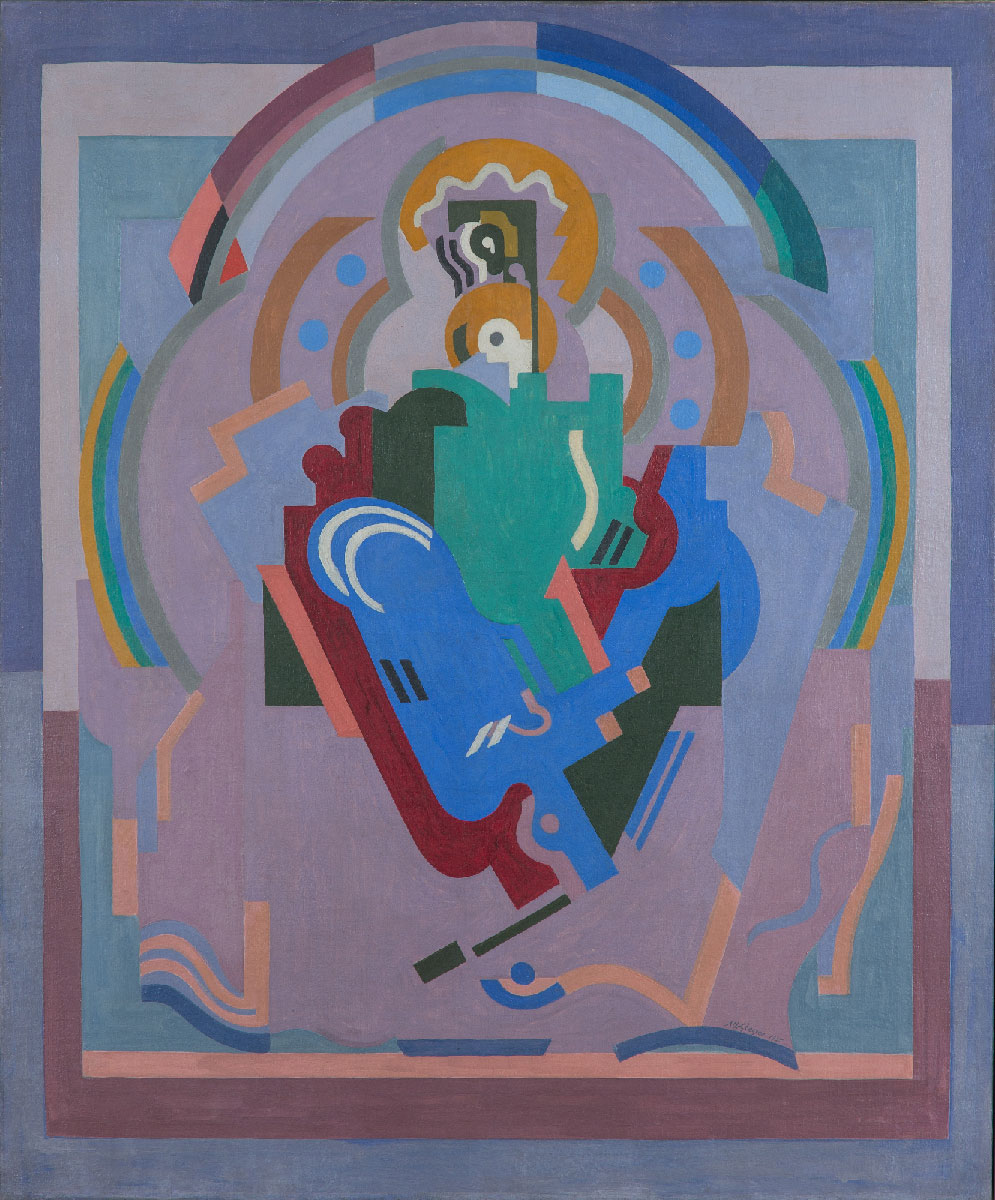
Albert Gleizes (Paris 1881 – Saint-Rémy-de-Provence 1953) Glorious motherhood, 1935 Oil on canvas Albert Gleizes Foundation Depot, Paris In this painting that updates the Christian iconography of the Virgin and the Child, Gleizes envelops the blue, green and red central areas of a network of concentric circles where we find the modified colors of the central accord. For Gleizes, this is a relationship of order between color and light, whose model he finds in the motif of the «Rainbow», inherited from Romanesque painting, which will take more and more importance in his work. This painting, which was published in 1936 in the journal Abstraction-Création, is a manifesto: sacred art can go well with the language of abstraction, as formalized in the 1930s. Credits: Albert Gleizes, Maternité Glorieuse © Fondation Albert Gleizes, photo Fabrice Lepeltier - Adagp, Paris 2023
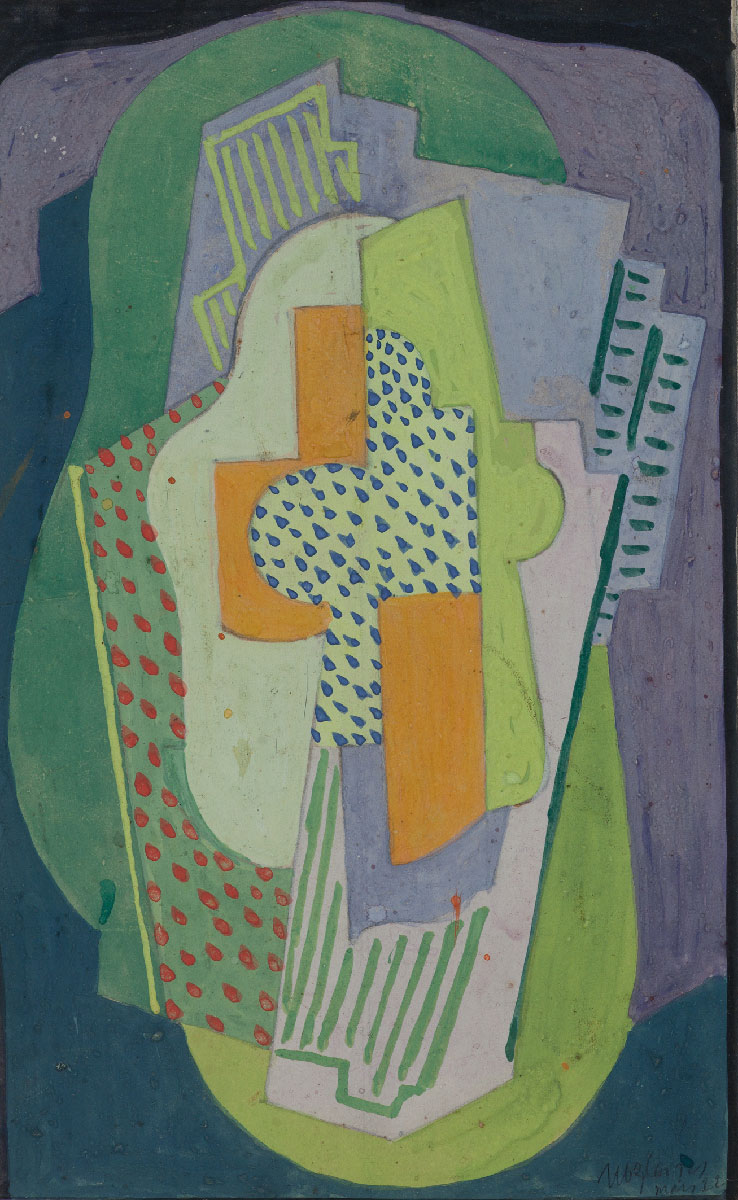
Albert Gleizes (Paris 1881 – Saint-Rémy-de-Provence 1953) Composition, 1922 Gouache on paper glued on cardboard Purchase of the Friends of the Estrine Museum Inv. ME.2003.17 In 1922, pushed by his first students, Gleizes began writing his book Painting and its laws where he developed and clarified his plastic theories: «To paint is to animate a flat surface, it is to rhythm the space». For this, the artist defines two fundamental notions: «translation» and «rotation» of the planes. The first one is interested in the right planes that it envisages in lateral displacements from right to left (and vice versa) or combined. The second, as its name suggests, considers the variations of the oblique planes within the circle. The association of the «translation» and the «rotation» reveals shapes treated in flat areas which underline the different animations of the plane. This seductive work is one of the first illustrations. Credits: Albert Gleizes, Composition - ME.2003.17 © Musée Estrine, cliché Fabrice Lepeltier - Adagp, Paris 2023

Juliette Roche

André Marchand