Estrine HOTEL
History of the Building
When Saint-Rémy-de-Provence Became Monegasque…
First a royal possession of the Count of Provence and then of Jean of Anjou, Saint-Rémy-de-Provence subsequently became aristocratic, a lordship of the Forbin family. However, it was in 1643 that a new lord took possession of the place: Prince Honoré II of Monaco.Indeed, deprived of their authority over the Rock by the Spanish forces of Charles V, the Grimaldi family carried out a reversal of alliance in favour of France, formalized by the Treaty of Péronne of 14 September 1641. This treaty came with compensation granted to Prince Honoré: the Duchy-Peerage of Valentinois, the Marquisate of Les Baux, the County of Carladès in Auvergne and, finally, the Lordship of Saint-Rémy.
Monegasque rule over Saint-Rémy, however, remained discreet. Until 1791, when the territory was reclaimed by Revolutionary France, without nevertheless depriving the Prince of Monaco of his title over the town, the Grimaldi family came only rarely. The governing institutions already in place, originally royal, underwent almost no modification. The local officials, on the other hand, became double agents, since these officers of Saint-Rémy acted both in the interests of the King of France and in those of the Prince of Monaco.
It is within this context that Joseph Bertrand Pistoye enters the scene. Initially a lawyer from Aix at the Parliament of Provence, it was through his marriage in 1748 that Pistoye entered the royal judiciary in Saint-Rémy, the starting point of an accumulation of offices. A royal judge, Pistoye would also hold the position of viguier (a royal officer embodying the king’s justice) and representative of the Princes of Monaco. In 1763, Pistoye sought a seat on the town council, leading to a lawsuit that marked the high point of the Saint-Rémois’ growing dislike of this figure. The revolutionary events would ultimately put an end to the Pistoye family’s hold and to the authority of the Grimaldi family over Saint-Rémy.
A Townhouse Befitting the Office
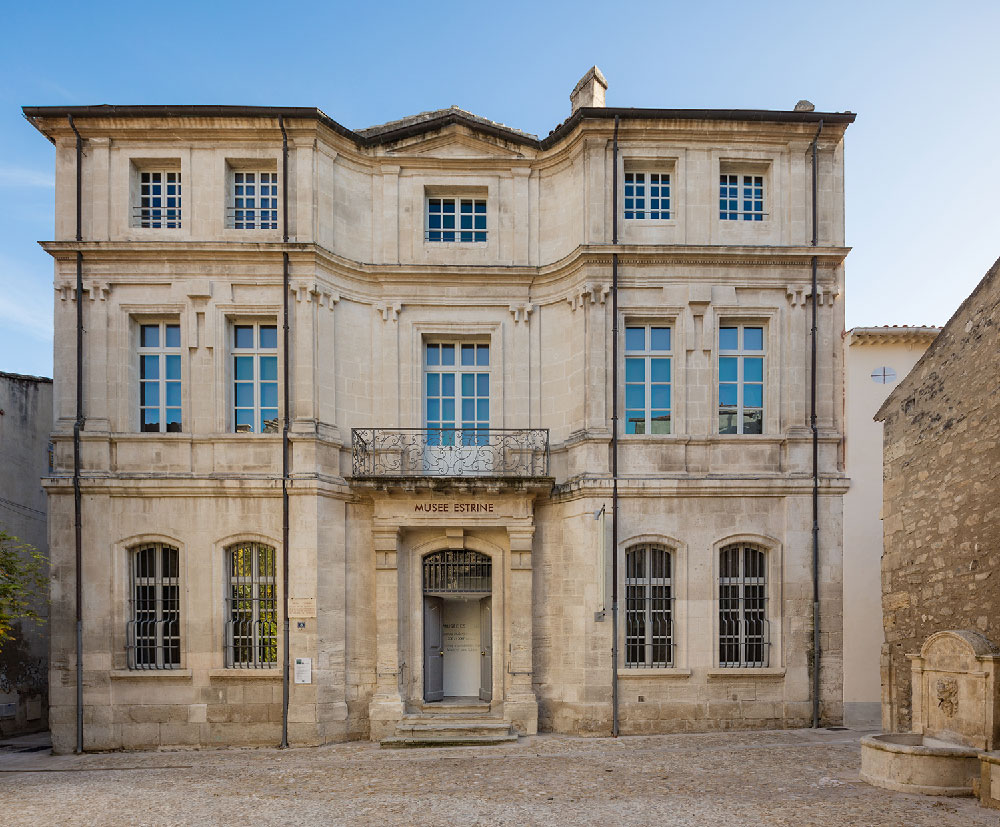
Built in 1748 for Joseph-Bertrand Pistoye, the present-day Hôtel Estrine served clear objectives. Imposing through its verticality and remarkable for overlooking the surrounding small houses, this residence was more a showcase of the Pistoye family’s socio-economic success than simply a family home.
In the middle of the eighteenth century, the townhouse played a role in the exercise of self-representation. By owning a prestigious property facing the street, aristocrats and members of the bourgeoisie expressed their status and wealth through imposing façades and elaborate architectural ornamentation. While the most lavish of these buildings were located in and around Paris, many townhouses were also built in the provinces.
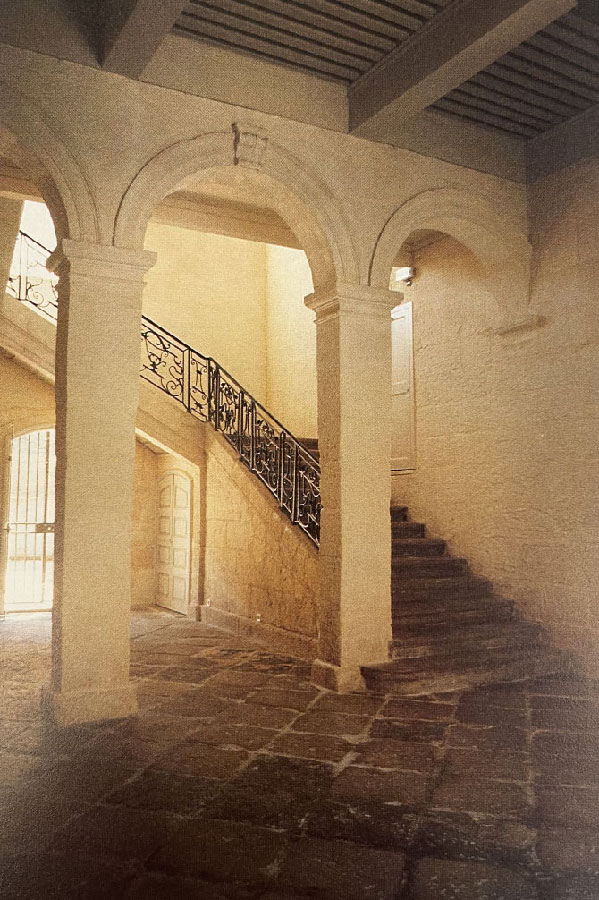
Hôtel Estrine presents a balanced ashlar stone main façade rising over three storeys. On the ground floor, after passing through the large doorway framed by four windows whose iron grilles date from 1748, one enters the entrance hall. Through its columns and arches, the hall reflects the taste of the mid-eighteenth century for the Antique style, stimulated by the excavations of the ruins of Herculaneum and Pompeii, which began in 1738. (The presence of ancient monuments in Saint-Rémy was probably not unrelated to this taste for Antiquity; the triumphal arch and the mausoleum had already attracted the attention of King Charles IX during his grand tour in the sixteenth century.)
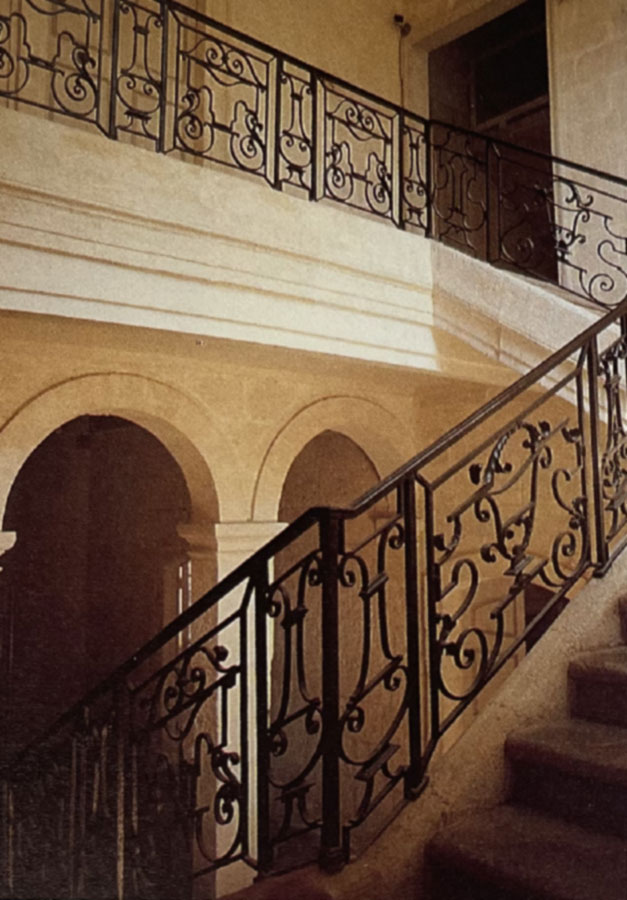
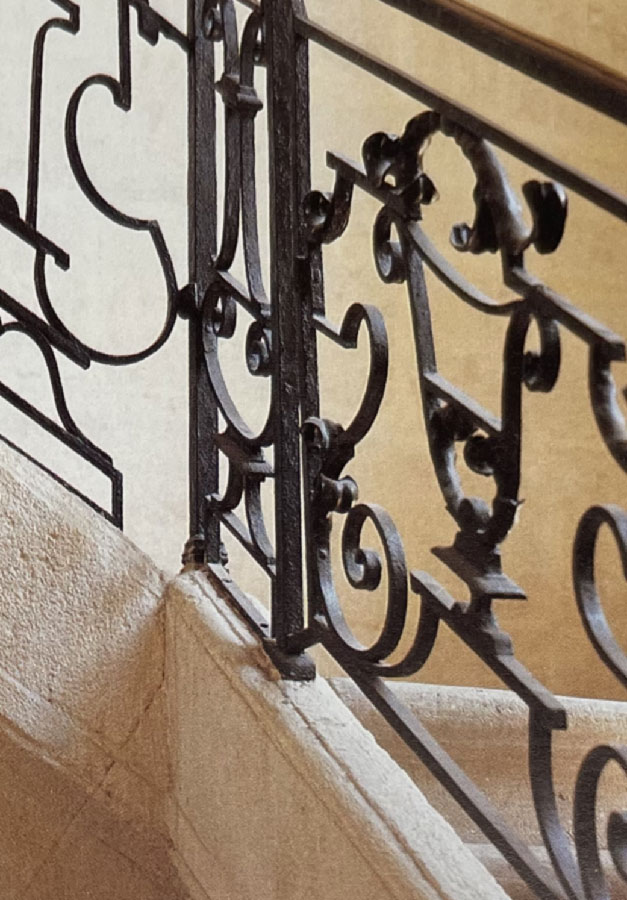
The half-turn staircase leading to the noble floor is enhanced by an elegant period wrought-iron balustrade, whose graceful interlacing motifs recall the abundance of Rocaille ornamentation then fashionable in aristocratic interiors under Louis XV.
On the first floor, a suite of three reception rooms presents a combination of influences: French-style ceilings (plafonds à la française); plaster decorations above the door pediments whose decorative vocabulary belongs to the Rocaille style (ribbons, intertwined foliage, tasselled tiebacks, handled craters); and others depicting musical instruments (kettledrum, violin, clarinet). The marble fireplaces, meanwhile, reveal through their composition and ornamentation a more Neoclassical style, which became fashionable at the end of the eighteenth century.
On the second floor stands a fireplace characteristic of the late eighteenth century. Playing on the contrast between its black and white marbles, its jambs are curved and decorated with acanthus leaves. The lintel is crowned by a bas-relief depicting a fluted vase inspired by Antiquity, draped with a cloth held on either side of the vase in the beaks of eagles with outstretched wings. The fireback features abundant chinoiserie decoration.
History of the Museum
The Estrine Family
During the Reign of Terror, François Pistoye, heir of Joseph Bertrand Pistoye and considered a counter-revolutionary, was sentenced to death by the Revolutionary Tribunal and guillotined in 1794. The Prince of Monaco was deprived of his lands in Saint-Rémy, retaining the title of lord only as an honorary distinction, and thus the town entered a new era. An era unfavourable to the actors of the Ancien Régime, such as Madame Pistoye, who was forced to sell the townhouse to Louis Estrine.
Louis de Gonzague-Pierre-Marie Estrine, born in Marseille in 1752, was a master rope-maker and a figure of the Revolution. Estrine took part in the municipal assembly of the three estates, where he was elected for the first time in 1790, and there he renewed six times the oath to remain faithful to liberty and equality. In 1796, Louis Estrine retired to his townhouse in Saint-Rémy, where he remained until the end of his life.
His son, Louis-Nicolas, became a “tax collector for life” and resigned from this position in 1827. One of his sons, Louis-Alphonse, in turn became a tax collector and died in the family townhouse without heirs. His nephew, Lucien Estrine, left his mark on his time: a lawyer, he was also a prominent businessman, serving as president of the Union of Associations of France and Algeria, the Society for the Defence of Commerce, and the Chamber of Commerce of Marseille. This Knight of the Legion of Honour regularly resided in Saint-Rémy.
The townhouse, firmly associated with the Estrine name, remained the property of this family until 1988, when it was purchased by the municipality and entrusted to the Présence Van Gogh Association in order to establish the Présence Van Gogh Art Centre there.
Restoration and Expansion of the Building
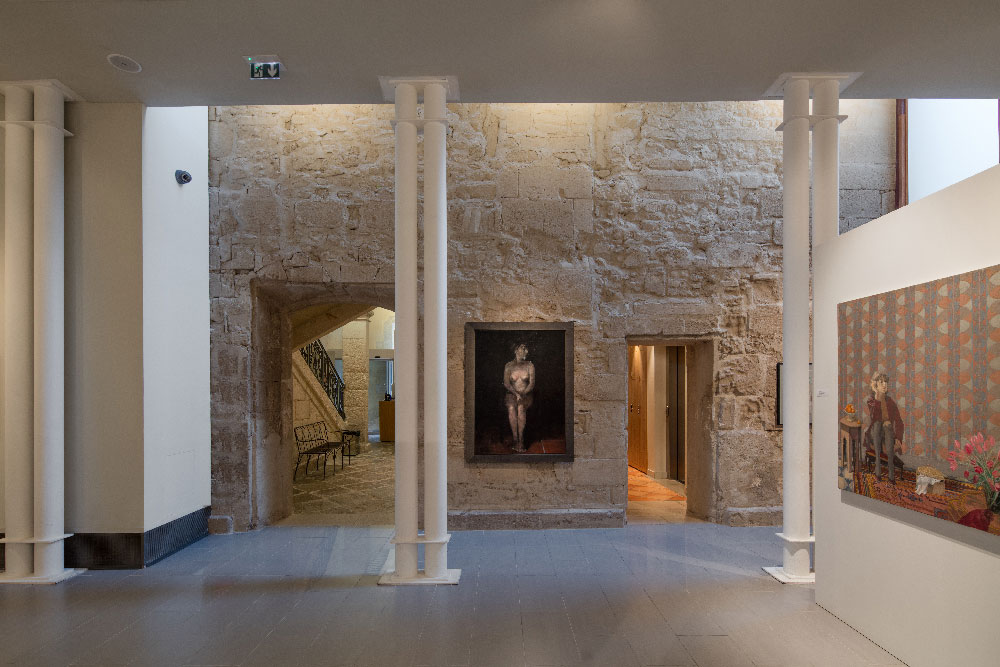
Two guiding principles have always directed the renovation of the building: restoring and preserving the architecture and spirit of the eighteenth-century townhouse, and installing the facilities and visitor circulation necessary for its reuse as an Art Centre. The work, begun in July 1988 and financed almost entirely through private patronage, was completed in February 1989. The building thus opened its doors to the public as an Art Centre in July 1989.
Since its opening, the Art Centre, dedicated to modern and contemporary painting and graphic arts, has continuously enriched its exhibition programme, highlighting painters and draughtsmen whose work was created in this great southern workshop, the agricultural valley of the Alpilles and particularly Saint-Rémy-de-Provence, in the artistic lineage of Van Gogh. Several major names in painting are represented in the museum’s collections: Eugène Leroy, Gérard Fromanger, Bernard Buffet, Albert Gleizes and Vincent Bioulès.
Through the spontaneous donations of artists invited to exhibit and the generosity of important donors (Violaine Menu-Branthomme, Marcel Puech, Philippe and Dominique Tailleur), the collections grew in importance, both quantitatively, with the ever-increasing number of works preserved, and qualitatively, forming a body of work of significant heritage value. This was confirmed in 2007 by the award of the label “Musée de France” (“Museum of France”): namely, “any permanent collection composed of assets whose conservation and presentation are of public interest and organised for the purposes of knowledge, education and public enjoyment” (Art. L. 410-1).
The awarding of this label, while confirming the scientific quality of the body of works preserved at the Estrine Museum, also required the museum to undertake extensions consistent with its new status. Thus, in 2014, a modern annex was built, designed with respect for the eighteenth-century setting it was intended to complement. Two exhibition galleries dedicated to temporary exhibitions were created, along with an interpretation centre devoted to the work of Vincent van Gogh, an educational workshop, new storage facilities and a hanging garden presented in the form of a planted parterre.